Trump’s Eyebrow Bruise Sparks Speculation About a Possible Fall

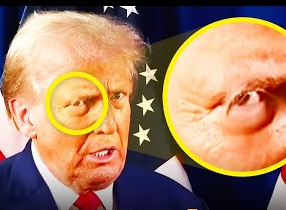
Public attention often turns quickly toward even the smallest details when it comes to well-known figures, and that was once again the case when Donald Trump appeared in public with what looked like a bruise near his eyebrow. The mark, though relatively minor in appearance, sparked a wave of online speculation and curiosity, with observers wondering whether it might be the result of a fall or simply a harmless, everyday incident. In an age where images circulate instantly and opinions spread even faster, moments like these highlight how public figures are constantly under a magnifying glass.
The situation began when recent photos and video footage showed a noticeable discoloration above Trump’s eye. While such a mark would likely go unnoticed on most people, it immediately caught attention due to his high profile and the intensity of public interest surrounding him. Social media platforms quickly became filled with commentary, with some users jokingly referring to the bruise as “radioactive,” while others speculated more seriously about its origin.
It is not unusual for people to draw conclusions based on limited visual information, especially when it involves someone who has long been a central figure in public life. Trump, who has remained highly visible in political and media circles, often finds himself the subject of close scrutiny. From his speeches to his appearance, nearly every detail becomes part of a broader public conversation. This latest moment is simply another example of how even small physical changes can prompt widespread discussion.
Despite the speculation, there has been no confirmed indication that the bruise is connected to anything serious. Minor injuries like bruises can happen for a variety of reasons, ranging from accidental bumps to routine daily activities. Medical experts frequently note that as people age, their skin can become more sensitive, making bruising more noticeable even after a light impact. Without official clarification, it remains important to avoid jumping to conclusions or assuming worst-case scenarios.
The public’s fascination with visible changes in well-known figures is not new. Throughout history, leaders and celebrities alike have faced similar scrutiny. Whether it is a change in hairstyle, a new outfit, or a small mark on the face, such details can take on outsized significance in the public imagination. In Trump’s case, his long-standing presence in the spotlight means that even subtle differences are quickly picked up by viewers and commentators.
Media coverage has also played a role in amplifying the conversation. News outlets and commentators have discussed the bruise in a variety of tones, from lighthearted curiosity to more serious speculation. While this type of coverage can generate interest, it also underscores the importance of responsible reporting. Focusing too heavily on unverified claims or dramatic interpretations can lead to misinformation and unnecessary concern.
At the same time, the public reaction reflects a broader cultural trend in which people feel closely connected to public figures. With constant access to images and updates, audiences often feel as though they are witnessing events in real time. This sense of immediacy can make even small developments seem significant. However, it also highlights the need for perspective, as not every visible detail carries deeper meaning.
Trump himself has not made a major issue of the bruise, and there has been no official statement suggesting that it is anything beyond a minor and temporary mark. This lack of emphasis from his side suggests that it may not be a matter of concern. In many cases, such marks fade quickly and are forgotten just as fast as they appeared.
It is also worth considering how quickly narratives can form in the digital age. A single image can be shared thousands of times within minutes, accompanied by a wide range of interpretations. Some of these interpretations are based on humor, while others may be rooted in genuine curiosity or concern. The challenge lies in distinguishing between speculation and verified information.
Public figures like Trump often serve as focal points for broader discussions, and this moment is no exception. Conversations about health, aging, and public transparency can all emerge from something as simple as a visible bruise. While these discussions can be valuable, they are most productive when grounded in facts rather than assumptions.
The phrase “radioactive,” used by some commentators, illustrates how language can shape perception. While clearly intended as a humorous exaggeration, such descriptions can also contribute to a sense of drama that may not reflect reality. It is a reminder that words, especially in widely shared posts, can influence how people interpret what they see.
In a more general sense, this situation highlights the importance of approaching visual information with caution. Photographs and videos capture only a single moment in time and may not provide the full context needed to understand what is happening. Lighting, camera angles, and other factors can all affect how something appears on screen. Without additional information, it is easy to misinterpret what is being shown.
As the conversation continues, it is likely that attention will shift to other topics, as it often does in the fast-moving world of news and social media. What seems like a major point of discussion one day can quickly be replaced by new developments the next. This cycle reflects the ever-changing nature of public interest and the constant flow of information in modern life.
Ultimately, the appearance of a small bruise serves as a reminder of the human side of even the most prominent individuals. Despite their visibility and influence, public figures are still subject to the same everyday experiences as anyone else. Minor bumps and bruises are a normal part of life, and in most cases, they do not carry deeper significance.
For observers, the key takeaway is the value of maintaining a balanced perspective. Curiosity is natural, especially when it comes to well-known personalities, but it is equally important to rely on verified information and avoid drawing conclusions without evidence. By doing so, discussions can remain thoughtful, respectful, and grounded in reality.
In the end, the brief attention surrounding Trump’s eyebrow bruise is less about the mark itself and more about how people respond to what they see. It highlights the speed at which information travels, the role of media and social platforms in shaping narratives, and the enduring fascination with public figures. As with many such moments, it will likely pass quickly, leaving behind a small but telling example of how modern attention works.